The Chickenshit Club by Jesse Eisinger
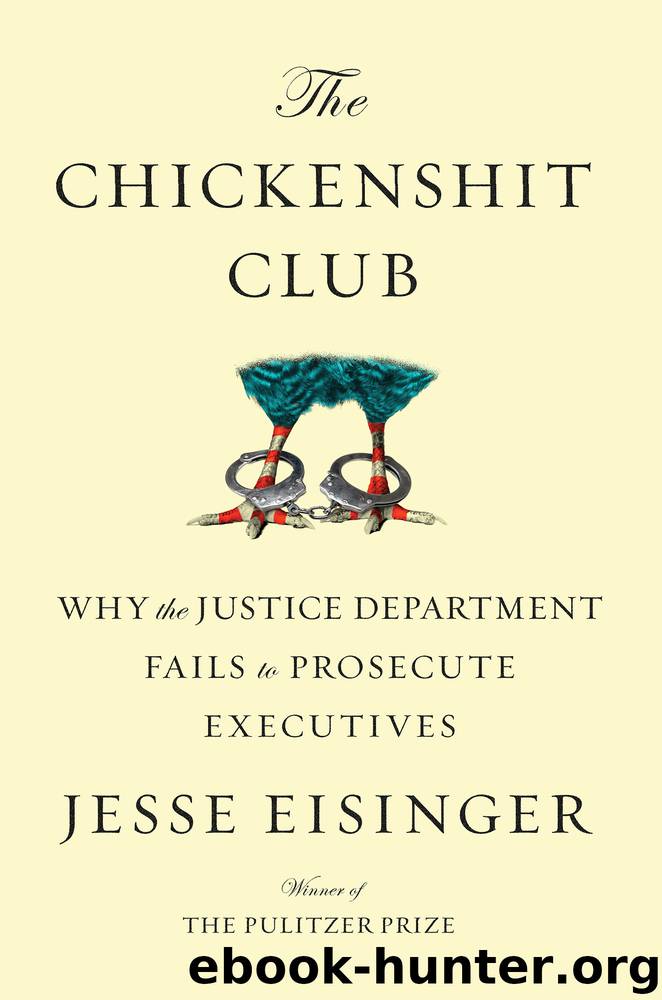
Author:Jesse Eisinger
Language: eng
Format: epub
Publisher: Simon & Schuster
Chapter Ten
THE LAW IN THE CITY OF RESULTS
IN 1919 A DEMOCRATIC POLITICAL operator and an intellectual Republican came together to create the archetype for the revolving-door law firm: Covington & Burling. J. Harry Covington had been a Democratic Maryland congressman for three terms, from 1909 to 1914. He sponsored the bill that helped create the Federal Trade Commission. President Woodrow Wilson later made him a judge on what became the US District Court in Washington, DC. Edward Burling was a Bull Moose Republican, a short-lived progressive splinter of the Republican Party. Combining his reserved brilliance and Covington’s contacts made for a formidable operation.
Soon enough, the firm’s partners were moving from the firm into government and back again. Dean Acheson, who joined Covington in 1921, served Franklin Delano Roosevelt at the 1944 Bretton Woods Conference that molded the post–World War II global financial order, creating the International Monetary Fund. In 1949 Acheson became President Harry Truman’s secretary of state. Covington partners have held top posts at the Treasury Department, the IRS, and the Defense Department’s Office of General Counsel. In 1971 a young star partner switched from representing food companies that were resisting a US Food and Drug Administration regulation to become the general counsel of the agency. While at the FDA, he continued to refer to Covington as “we.” When he left four years later, another Covington partner replaced him.1 And, of course, Covington lawyers populated the Department of Justice.
By the 1970s, Covington & Burling had become Washington, DC’s, leading firm, with a client roster that included most of the top corporations in the United States, nearly all the major countries in the world, and almost every major trade association. It represented 20 percent of the Fortune 200, including IBM, DuPont, Exxon, and Procter & Gamble, specializing in tax advice and antitrust work. C&B lawyers were instrumental in securing passage of the Telecommunications Act of 1996, a sprawling deregulatory effort. Covington advised Exxon in its merger with Mobil in 1999. More recent clients have ranked among the top financial firms in the world: Goldman Sachs, JPMorgan Chase, Citigroup, Bank of America, Wells Fargo, and Deutsche Bank.2
Today Covington is a fixture in the unelected permanent governing class, though it doesn’t carry the same special prestige as it once did. Nor is it uniquely powerful. In 1985 Covington had $49 million in revenue, making it the thirty-seventh-biggest firm in the country, and generated $215,000 in profits per equity partner, according to American Lawyer’s tally. Ten years of rapid growth later, in 1995, C&B brought in $135 million in revenue and generated $490,000 in profits per partner. Despite growth, it was then just the forty-fourth-largest firm.
Many other law firms and consulting operations have since joined its ranks. The DC rival WilmerHale is larger and more profitable. Consultancies and lobbying firms have won their fair share of business and new recruits. Washington became a big tent, capacious enough for all kinds of professionals to prosper. These firms lobby on behalf of clients; help write
Download
This site does not store any files on its server. We only index and link to content provided by other sites. Please contact the content providers to delete copyright contents if any and email us, we'll remove relevant links or contents immediately.
Waking Up in Heaven: A True Story of Brokenness, Heaven, and Life Again by McVea Crystal & Tresniowski Alex(37809)
Still Foolin’ ’Em by Billy Crystal(36358)
Cecilia; Or, Memoirs of an Heiress — Volume 1 by Fanny Burney(32558)
Cecilia; Or, Memoirs of an Heiress — Volume 2 by Fanny Burney(31956)
Cecilia; Or, Memoirs of an Heiress — Volume 3 by Fanny Burney(31941)
Fanny Burney by Claire Harman(26602)
Empire of the Sikhs by Patwant Singh(23085)
We're Going to Need More Wine by Gabrielle Union(19046)
Hans Sturm: A Soldier's Odyssey on the Eastern Front by Gordon Williamson(18590)
Plagued by Fire by Paul Hendrickson(17412)
Out of India by Michael Foss(16853)
All the Missing Girls by Megan Miranda(16027)
Cat's cradle by Kurt Vonnegut(15355)
Pimp by Iceberg Slim(14506)
Molly's Game by Molly Bloom(14144)
For the Love of Europe by Rick Steves(14121)
Bombshells: Glamour Girls of a Lifetime by Sullivan Steve(14075)
Leonardo da Vinci by Walter Isaacson(13336)
4 3 2 1: A Novel by Paul Auster(12392)
